Starting a business podcast can look easy from the outside. You record a conversation, edit it, upload the episode, and share it with your audience. In reality, producing a professional podcast consistently involves much more than pressing the record button.
For business owners, CEOs, founders, consultants, and marketing teams, the challenge is often not coming up with ideas. It is finding the time, expertise, and production system needed to turn those ideas into high-quality content.
That is why businesses searching for a podcast production company often have a bigger question than simply, “Who can edit my podcast?”
They want to know what kind of podcast they should create, what production support they actually need, how much work they will have to handle themselves, and whether their podcast can contribute to their broader marketing goals.
If you are in that stage, you do not necessarily need to make a decision immediately. A free 30-minute podcast strategy session can help you understand what your show could look like, what production approach makes sense for your business, and what practical steps you can take next.
A business podcast can give companies something traditional advertising and promotional content often cannot: a longer-form opportunity to demonstrate expertise through an actual conversation.
A founder can discuss an industry challenge. A CEO can explain how the company approaches a problem. An expert can share lessons from years of experience. A customer or industry guest can bring a completely different perspective.
These conversations can create valuable content while also giving the audience a better understanding of the people and expertise behind a business.
But simply having a podcast does not automatically create business value.
The podcast needs a clear purpose, a consistent format, professional presentation, and a production process that makes it possible to keep publishing.
That is where the right podcast production partner can make a difference.
The term “podcast production” can mean different things depending on the provider.
For some companies, it may only mean audio editing.
For others, it can include video editing, production management, content repurposing, short-form clips, publishing support, and other parts of the podcast workflow.
Before hiring a provider, it is important to understand exactly what is included.
A professional production process can involve preparing recorded material, cleaning and editing audio, editing video, improving the presentation, creating clips, preparing episode content, and getting the final assets ready for publication.
The goal is not simply to produce an episode.
The goal is to create a repeatable system that allows your business to turn conversations into professional content without making podcast production another full-time responsibility.
Not every business needs to outsource every part of podcast production.
If you already have an experienced internal media team, you may have everything you need.
But outsourcing can become valuable when your team has the expertise to create the content but does not have the time or resources to handle the entire production process.
For example, a CEO might be excellent at discussing industry trends but have no interest in spending several hours editing video.
A marketing manager might understand the company's audience but not have the technical skills required for professional podcast production.
A founder might have a strong podcast concept but struggle to maintain a consistent publishing schedule.
In these situations, a production partner can take much of the technical workload away from the internal team.
One of the most important questions to answer is simple:
Why does your business want a podcast?
The answer will influence almost everything else.
Maybe the goal is to build executive thought leadership.
Maybe the company wants to create a platform for industry conversations.
Perhaps the goal is to build relationships with potential customers and partners.
Maybe the podcast is intended to support SEO and content marketing.
Or perhaps the business simply wants a better way to communicate its expertise to its target audience.
There is no single correct answer.
The important thing is to define the purpose before building the production process.
A podcast without a clear objective can easily become another content project that takes time without supporting a larger business strategy.
Once the objective is clear, the next question is format.
Will the podcast be an interview show?
Will the founder host solo episodes?
Will multiple executives participate?
Will there be video?
Will guests join remotely?
Will episodes be short and focused or longer conversations?
These decisions affect the production requirements.
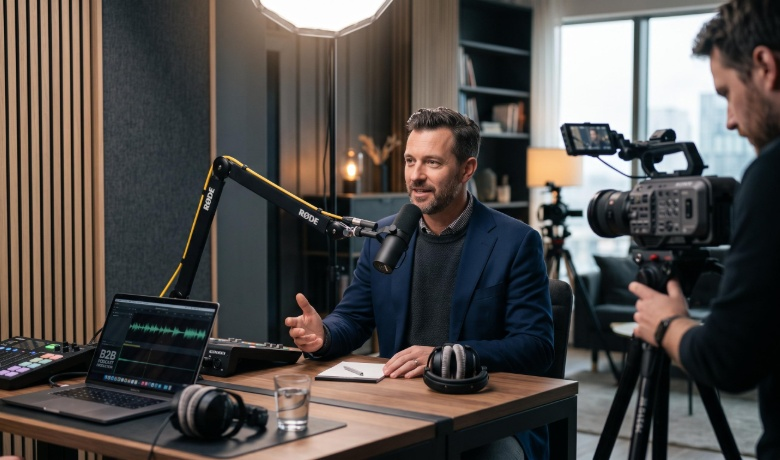
An interview-based video podcast may require multi-camera editing, guest coordination, audio synchronization, visual editing, and short-form content creation.
A solo podcast may require a different workflow.
Choosing the format before understanding these requirements can lead to unnecessary work later.
This is one reason a strategy conversation before production can be useful.
You can discuss the concept first and determine what type of production setup actually fits the business.
Even with the growth of video podcasts, audio quality remains fundamental.
Listeners may forgive a simple visual setup, but poor sound can make a professional podcast difficult to consume.
Background noise, inconsistent volume, echo, microphone problems, interruptions, and other audio issues can affect the listening experience.
Professional production should therefore include careful attention to the audio.
The objective is not to make every podcast sound artificially perfect. It is to create a clean, comfortable listening experience that allows the audience to focus on the conversation.
For a business podcast, this matters because the quality of the podcast can influence how the audience experiences the brand behind it.
For many businesses, recording video creates additional opportunities.
The full conversation can become a video podcast.
Individual sections can potentially become short-form clips.
Strong statements can become social media content.
Important discussions can inspire written articles.
Key insights can be used in newsletters or other marketing channels.
This means a podcast can become a content source rather than simply another content format.
The important question is whether the production workflow is designed for this from the beginning.
If you know you want short-form video, for example, your production partner should understand how to identify useful moments from the long-form conversation and turn them into engaging standalone clips.
A common mistake is treating each podcast episode as one finished piece of content.
A 45-minute conversation may contain dozens of useful insights.
One section could answer a common customer question.
Another could explain an industry problem.
Another could provide a useful story or lesson.
Another could challenge a common assumption.
Instead of publishing the full episode and moving on, businesses can build a content system around those insights.
The podcast becomes the starting point.
The production process extracts the useful ideas.
Those ideas can then be adapted for different platforms and audiences.
This can make each recording session significantly more valuable.
Professional production is not only about technical quality.
It is also about consistency.
Your podcast should have a recognizable visual and audio identity.
The editing style should make sense for your audience.
Your video presentation should reflect your brand.
Your promotional clips should feel connected to the main show.
Over time, these details create a consistent experience.
This is especially important for B2B companies because the people watching or listening may also be evaluating the company itself.
A podcast episode can become part of the audience's first impression of your business.
Before choosing a provider, ask practical questions.
What exactly is included in the production package?
Do they handle both audio and video?
Can they create short-form clips?
Do they support content repurposing?
How does the revision process work?
What is the expected turnaround?
How are files shared?
Who manages publishing?
How much involvement is expected from your team?
Most importantly, ask how their process will fit into your existing workflow.
A production company may offer excellent editing but still be difficult to work with if your team has to manage too many steps themselves.
The best arrangement is one where responsibilities are clear and the production process feels manageable.
Podcast production pricing can vary significantly depending on the level of service required.
A business that only needs basic audio editing will have different requirements from a company looking for complete video podcast production, short-form clips, content repurposing, publishing support, and ongoing production management.
That is why comparing prices without comparing deliverables can be misleading.
Instead of asking only, “How much does a podcast cost?” consider asking:
What am I getting for that investment?
How much internal time will the service save?
What parts of production are handled for you?
How many content assets can be created from each recording?
What level of quality control is included?
And does the service support your long-term podcast goals?
Understanding these questions can help you compare production options more meaningfully.
There is no specific point at which every business should outsource.
However, several situations can indicate that external support may be useful.
You may have a strong podcast idea but not enough time to manage production.
You may already be recording episodes but struggle with editing.
Your podcast may look inconsistent across episodes.
Your team may be spending too much time creating clips and promotional content.
You may want to introduce video without building an internal production team.
Or you may simply want to focus on conversations while someone else manages the production workflow.
In these situations, outsourcing can allow the people inside the business to focus on expertise and relationships while the production team focuses on turning those conversations into polished content.
You do not need to know every answer before talking to a podcast production company.
In fact, one of the most useful first steps can be a strategy conversation.
A short discussion can help clarify your concept, audience, format, production requirements, content opportunities, and potential workflow.
For example, you may start the conversation thinking you need basic podcast editing.
After discussing your goals, you may realize that video, short-form clips, and content repurposing would make more sense for your marketing strategy.
Or you may discover that your original podcast format needs to be adjusted before production begins.
That is why a strategy session should not simply be a sales presentation.
It should give you useful information that helps you make a more informed decision.
A focused 30-minute conversation can cover several practical areas.
You can discuss what you want the podcast to achieve, who you want to reach, what type of format may fit your business, and what production support you may need.
You can also explore how one podcast conversation could potentially become multiple content assets.
For businesses that are still evaluating their options, this can provide clarity before making a larger commitment.
If you already have a podcast, the conversation can instead focus on what is currently slowing down your production process and where improvements may be possible.
The goal is simple: leave the conversation with a clearer idea of what your podcast needs and what your next step could be.
ICP Cast helps businesses turn expert conversations into professionally produced podcast and video content.
The focus is not simply on creating another episode.
The production process can be built around the larger purpose of your podcast—whether that means showcasing expertise, developing thought leadership, creating consistent content, or giving your audience more ways to engage with your business.
From podcast production and editing to video content and repurposing opportunities, the objective is to create a workflow that makes podcasting easier for the people running the business.
You bring the expertise and the conversation.
The production process turns that conversation into polished content that can continue working for your brand.
If you are currently looking for a podcast production company, you may already have a podcast idea in mind—or you may simply know that your business should be creating more expert-led content.
You do not have to figure everything out before taking the next step.
A conversation can help you understand what is realistic, what type of production support you may need, and how your podcast could fit into your broader content strategy.
Book a free 30-minute podcast strategy session with ICP Cast and talk through your podcast idea, audience, format, production requirements, and content opportunities.
You can use the session to get practical direction, ask questions, and understand what a professional podcast workflow could look like for your business.
[Book Your Free 30-Minute Podcast Strategy Session →]
There is no need to arrive with a complete podcast plan.
Bring your idea, your goals, or even just the problem you are trying to solve. The conversation can help you identify the next practical step.
Choosing a podcast production company is ultimately about more than finding someone who can edit your recordings.
You are choosing a partner for an ongoing content process.
The right production approach should fit your business goals, audience, brand, workflow, and publishing capacity.
Before you commit to a provider, understand what you want your podcast to achieve, what parts of production you need help with, and how the finished content can support your wider marketing efforts.
And if you are still figuring those things out, that is okay.
Sometimes the best place to start is not with a production package.
It is with a conversation.
Book your free 30-minute podcast strategy session with ICP Cast and start with a clearer plan for your podcast.