Starting a business podcast sounds simple.
You choose a topic, invite a guest, record a conversation, and publish the episode. At least, that is how it looks from the outside.
In reality, recording is only one part of the podcast production process.
Once the microphone is turned off, there is still a significant amount of work involved before an episode is ready for your audience. Audio needs to be cleaned. The video may need to be edited. Mistakes and unnecessary sections need to be removed. Short clips need to be created for social media. Show notes, titles, descriptions, thumbnails, and other content may need to be prepared.
For a business owner, CEO, consultant, coach, or industry expert, that hidden workload can quickly become a problem.
The question is not simply, “How long does it take to record a podcast?”
The more important question is:
“How much of my time does producing one complete podcast episode actually require?”
If you're considering professional business podcast production, understanding the full workflow can help you decide whether to manage everything internally or outsource the production process.
A typical podcast conversation might take 30 to 60 minutes to record.
That does not mean the episode takes 30 to 60 minutes to produce.
After recording, the raw files have to go through several stages before publication.
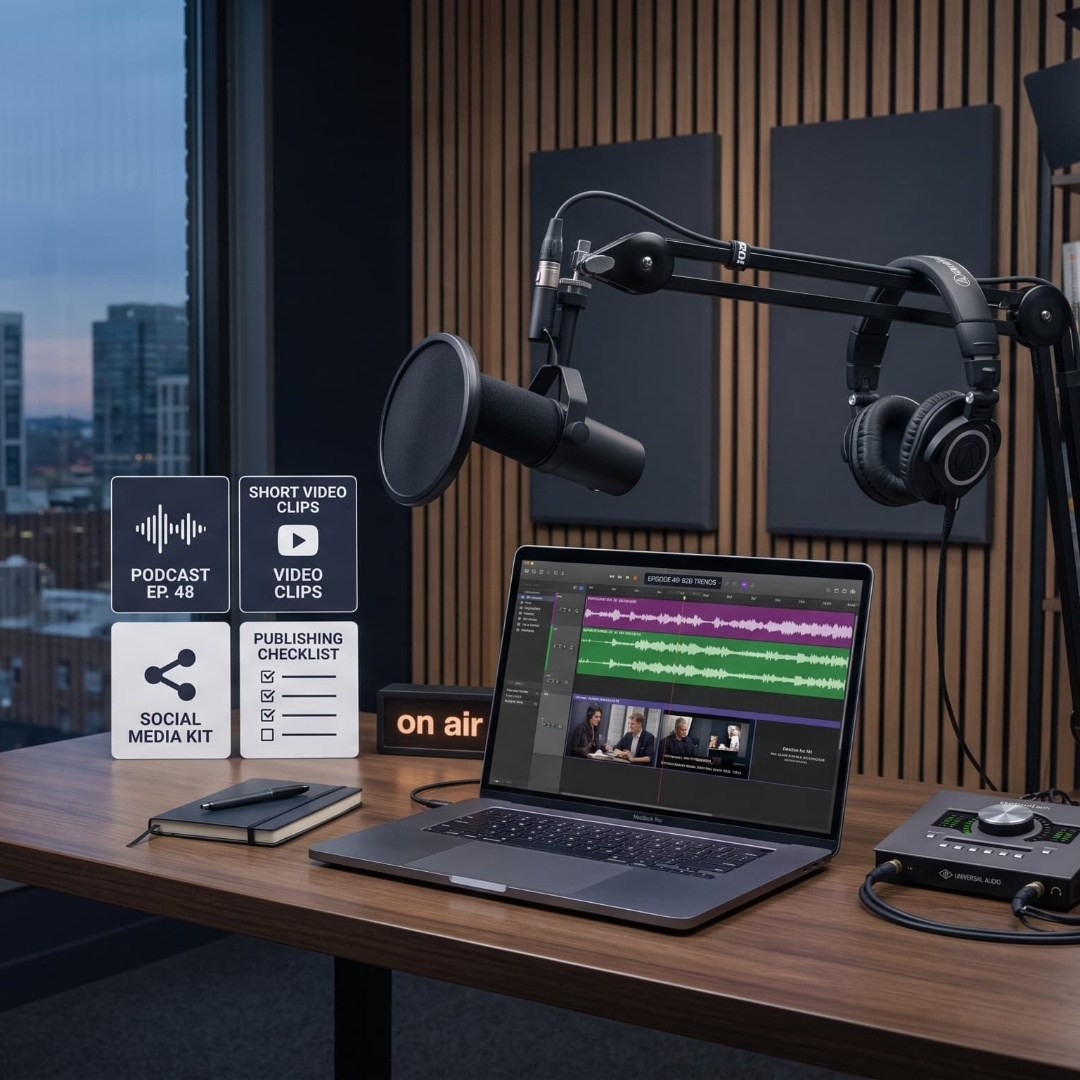
For example, one business podcast episode may involve:
The exact workload depends on the format, number of speakers, recording quality, editing requirements, and number of content assets you want from each episode.
This is why businesses often underestimate the real time commitment involved in podcasting.
There is no single number that applies to every podcast.
A simple audio-only episode with minimal editing can take relatively little production time. A video podcast with multiple cameras, branded graphics, social clips, and extensive repurposing can require significantly more work.
For a business podcast, you should think about production as a complete workflow rather than a single editing task.
Before editing begins, the production team needs to organize the recording files.
This can include downloading or transferring audio and video files, checking that the files are complete, organizing different camera angles, syncing audio and video, and preparing the project for editing.
Even when the actual recording was only 45 minutes, handling multiple files can add additional production time.
For recurring podcasts, this process also needs to happen consistently every week or every month.
Audio quality matters because listeners may forgive a simple visual style, but poor sound can make a professional podcast difficult to consume.
Audio editing can involve removing background noise, reducing unwanted sounds, balancing volume levels, cutting mistakes, improving clarity, and making sure the final audio is comfortable to listen to.
If your podcast includes multiple speakers, remote recordings, or inconsistent microphones, the editing process can become more complicated.
Professional podcast editing is therefore more than simply cutting the beginning and end of a recording.
Video podcasts add another layer to the production process.
The editor may need to work with multiple camera angles, screen layouts, speaker views, graphics, transitions, captions, and branding elements.
For a business podcast, the visual presentation also represents your brand.
A clean, consistent video can make the podcast feel like part of your company's broader content strategy rather than simply a recorded Zoom conversation.
This is especially important if you plan to publish episodes on YouTube or use video clips across LinkedIn, Instagram, Facebook, or other social platforms.
Real conversations are rarely perfect.
Guests pause. Speakers repeat themselves. Someone may lose their train of thought. A conversation may go off-topic.
Editing helps turn a raw conversation into a more polished episode.
The goal isn't necessarily to remove every natural moment. Instead, the production process should improve the overall flow while keeping the conversation authentic.
Depending on the recording, this can take considerably longer than simply watching the episode once.
One of the biggest opportunities in business podcasting is content repurposing.
Your podcast should not necessarily end with one published episode.
A single conversation can potentially become:
This is where podcasting becomes much more valuable for businesses.
Instead of treating the podcast as a standalone media project, you can use each conversation as a source of multiple pieces of marketing content.
But there is a tradeoff.
More content requires more production work.
Someone has to identify the strongest moments, edit the clips, create captions, prepare the written content, and format everything for different platforms.
That is often where business owners discover that producing a podcast themselves takes much more time than expected.
Imagine you record a 45-minute interview.
After recording, you want:
The recording itself might take less than an hour.
But producing all of those assets requires reviewing the conversation, identifying useful moments, editing them, writing content, formatting everything, and preparing the final files.
If you are doing everything yourself, you are no longer spending one hour on your podcast.
You are managing a small content production workflow.
And if you publish every week, that workload repeats every week.
The biggest cost of DIY podcast production isn't always money.
It is time and attention.
Business owners already have responsibilities such as managing clients, sales, employees, operations, marketing, and business development.
Spending several additional hours every week editing videos, creating clips, writing descriptions, and uploading episodes can pull attention away from those activities.
There is also another issue: consistency.
A podcast might start with a lot of enthusiasm.
The first few episodes get published on time. Then business gets busy. An episode is delayed. Another week is missed. Eventually, the podcast loses momentum.
This is one reason having a defined production workflow matters.
Outsourcing can make sense when the podcast is strategically important to your business but the production work is not the best use of your internal team's time.
You might consider professional podcast production services if:
Your podcast is part of your lead-generation strategy.
You want consistent publishing without personally managing every production step.
You want both audio and video versions.
You want professional short-form clips from every episode.
You want to turn podcast conversations into additional marketing content.
You do not have an in-house editor.
Or you simply want to focus on recording and let someone else handle everything after the conversation ends.
The key idea is simple:
You should not have to become a video editor just because you want to build authority through podcasting.
A professional workflow can make the process much easier for the person hosting the podcast.
Instead of the host managing every technical task, the workflow can be divided into clear stages.
The host focuses on the conversation.
This is where your expertise, experience, opinions, and stories become the raw material for the content.
The raw audio and video files are transferred to the production team.
The production team cleans the audio, edits the video, removes unnecessary sections, and prepares the episode according to the agreed style.
Important moments from the conversation can be turned into short-form clips and other content assets.
Titles, descriptions, show notes, thumbnails, captions, and other required assets can be prepared.
The client reviews the finished content and requests any necessary changes.
The final episode and supporting content are prepared for distribution.
This workflow allows the business owner to spend more time doing what they actually want to do: having valuable conversations and sharing their expertise.
These terms are sometimes used interchangeably, but they can describe different levels of service.
Podcast editing usually focuses on improving the recorded audio or video.
Podcast production can cover a much broader workflow—from editing and content preparation to repurposing and publishing support.
If you are comparing podcast companies, don't look only at the phrase “podcast editing.”
Ask what is actually included.
Does the service include video?
Are short clips included?
Who creates the thumbnails?
Who writes the episode description?
Who handles publishing?
Is content repurposing included?
Understanding these details can help you compare services based on the actual workload being handled rather than just the advertised service name.
If you're outsourcing your podcast, the goal isn't simply to find someone who can cut video.
You need a production process that fits the way your business operates.
Look for a team that understands:
Consistency: Your episodes should maintain a recognizable quality and visual identity.
Business goals: The podcast should support your broader marketing strategy.
Content repurposing: Your long-form conversations should have opportunities to become additional content.
Communication: You should know what is happening at each stage of production.
Turnaround: A predictable workflow makes it easier to maintain your publishing schedule.
Branding: Your podcast should look and sound connected to your business.
Most importantly, the production process should reduce your workload rather than create another project for you to manage.
Of course you can.
With modern editing software, templates, AI tools, and online publishing platforms, almost anyone can learn the basic technical process.
The more important question is:
“Is producing my own podcast the best use of my time?”
If you enjoy editing and have several hours available every week, doing it yourself may be perfectly reasonable.
But if your primary role is running a business, serving clients, closing deals, leading a team, or building your authority, the calculation can be different.
Your time has an opportunity cost.
Every hour spent cleaning audio or cutting social clips is an hour that cannot be spent on another business activity.
The most valuable business podcasts are not simply collections of recorded conversations.
They can become ongoing content engines.
Your interview with one expert can create an episode, several social clips, written content, thought-leadership posts, and promotional assets.
That means the real value of your podcast is not only the 45 or 60 minutes spent recording.
It is what you can create from that conversation afterward.
That is why having the right production workflow matters.
A strong podcast production process allows you to focus on the part that only you can do: bringing your expertise, personality, questions, and perspective to the conversation.
The rest can be handled through a repeatable production system.
Producing a business podcast is much more than pressing “record.”
The recording may take 30–60 minutes, but the complete process can involve hours of editing, reviewing, repurposing, writing, designing, uploading, and publishing.
For businesses using podcasts to build authority, generate leads, develop relationships, or create content, that hidden workload can become significant over time.
The good news is that you don't necessarily need to handle every step yourself.
With the right podcast production services, you can focus on recording valuable conversations while a production team handles the work required to turn those conversations into polished, publish-ready content.
If your podcast is becoming difficult to manage—or you're planning to launch one but don't want the production workload to take over your schedule—it may be time to build a production workflow around your business instead of adding another task to your business.
Ready to spend less time managing your podcast and more time building your business?
Book a strategy call with ICP Cast and let's discuss what your podcast production workflow could look like.